
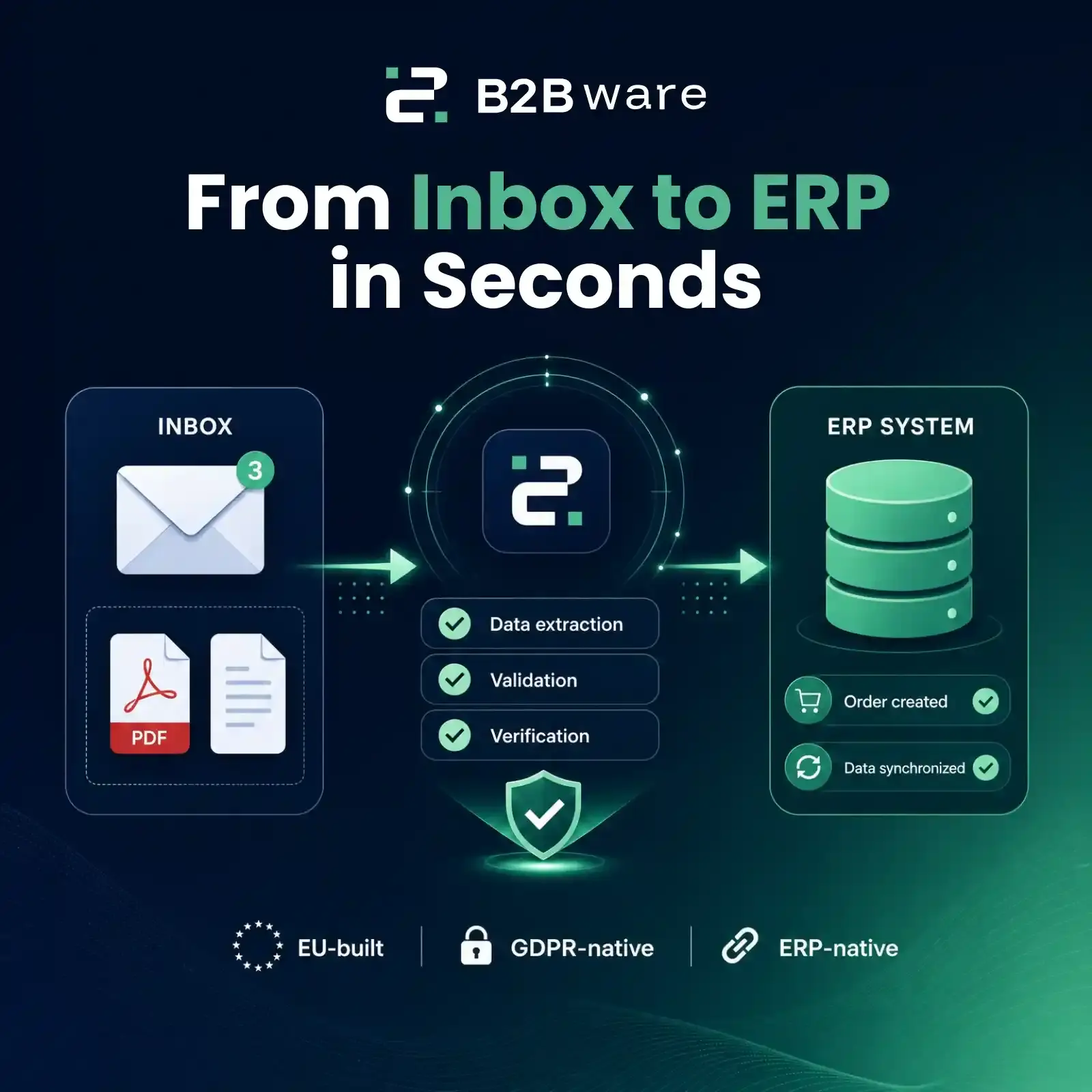
Every day, someone on your payroll opens an email order and types it into your ERP by hand. This AI reads each order the moment it arrives and writes it straight into Business Central, SAP, Sage or 400+ other systems. Your customers change nothing. The typing stops.
Trusted by























Stranzinger Logistik
Doppler & Co
Kienesberger Maschinen GmbH
Most B2B orders never moved online, and they’re not going to. Your customers email you, attach a PDF, or send a spreadsheet. Then a person on your payroll opens each one and types it into your ERP. It feels normal because everyone does it. Add up the hours, the typos, and who is doing the typing, it’s one of the most expensive habits in the business.
Your team copies every emailed order into Business Central, line by line. Those are the same people you want answering customers, not transcribing them.
Large merchants send purchase orders as PDFs, each in a different layout. Your team retypes them. No one is making those buyers change, so the orders have to be handled exactly as they land.
Product SKUs, quantities, dates keyed into your ERP by hand, order after order. It runs without breaking down, which is exactly what makes the cost invisible.
The cost of manual order entry isn’t only the hours it’s who’s spending them. Sales reps copying line items aren’t closing. Service staff transcribing PDFs aren’t solving problems. Fix the process and the people are freed. Nobody loses their job to this. They lose the data entry.
The real price of an order isn’t the order. It’s an hour of a salesperson’s day, repeated across every order, every day.
A wrong SKU or quantity turns into a credit note, a re-ship and an apologetic phone call. Caught late, every error costs more than the order it spoiled.
Anything arriving after hours queues until a human gets to it. Capture it the moment it lands and the fulfilment clock starts straight away.
The AI does the typing. Your team keeps the judgement. Nothing reaches your ERP until it has been checked.
1
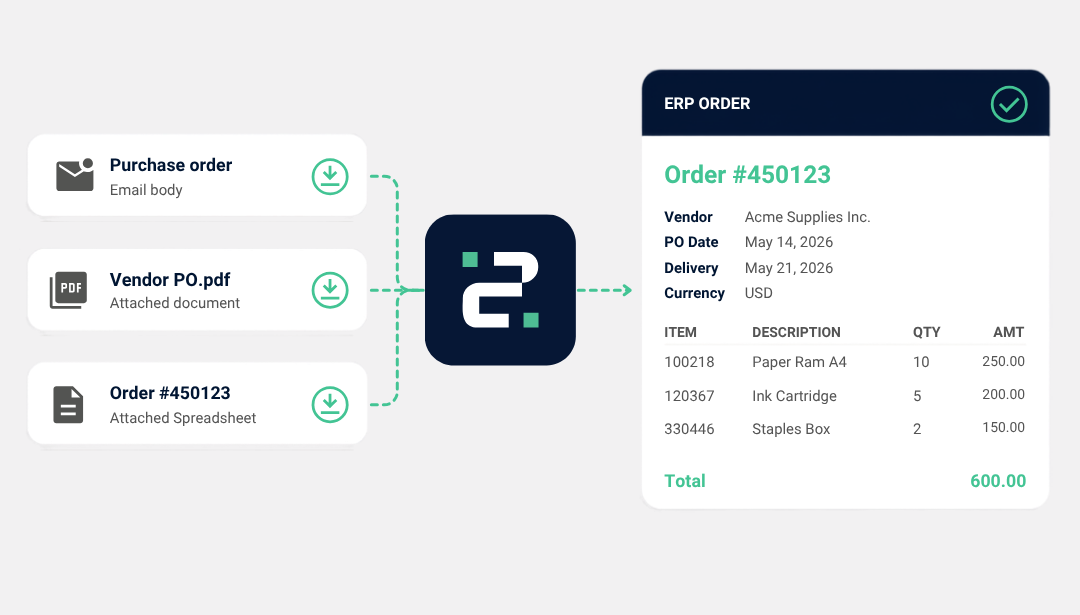
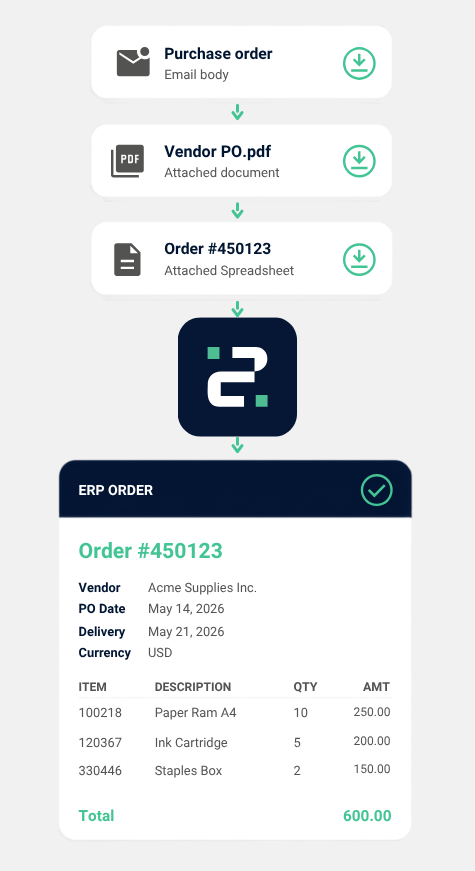
Email body, PDF, Excel, CSV. Nothing changes for your customer and there's no portal to roll out.
2
It pulls SKUs, quantities, dates and references, matches them to the right customer and your item master.
3
High-confidence lines go straight through. Anything ambiguous gets one specific question, answered in seconds. No silent guesses.
4
A structured sales order, ready to fulfil. Every step logged, reconcilable against your ERP line by line.
Schedule your free consultation and find out how B2Bware handles your order processing automatically.
This isn’t a chatbot someone has to prompt for every order. It’s a purpose built AI that sits on top of your ERP data your catalog, your pricing, your customers’ order history and uses it to read every order the moment it arrives.

SKUs, units, pricing and customer-specific terms are pulled live from your ERP, so the AI can match what a customer means not just what they typed.

Every line gets a confidence score before it goes anywhere. High-confidence lines pass straight through; anything below the line stops for a person with the reason attached.

"The usual", "same as last time", a half-written product name matched against that specific customer's order history, not a generic dictionary.

When a line is flagged, your team sees why which SKUs matched, what's ambiguous, and what the AI would have picked. Nothing is a black box.
General-purpose AI assistants are excellent at answering questions and drafting text. Running your order intake is a different job: something has to trigger itself on every inbound email, already know your catalog and customers, write structured data into your ERP, and leave a record your team can check. That’s the gap this AI is built to close.
| B2Bware AI | ChatGPT, Claude & other general AI assistants | |
|---|---|---|
| How it starts | Runs automatically on every inbound order | Someone has to notice the email and paste it in |
| What it knows | Your live catalog, pricing & customer history | Nothing about your products or customers, unless typed in each time |
| What it produces | A structured order written into your ERP | A text reply someone still has to enter into the ERP |
| Handling uncertainty | Confidence-scored per line; only real exceptions reach a person | One general answer, with no built-in "flag this line" step |
| Records | Every order logged and reconciled against your ERP | No record tied to your business systems |
| Scale | Runs unattended across hundreds of orders a day | One order, one person, one prompt at a time |
| Consistency | Same structured result every time, any format | Output varies with the prompt and the person writing it |
| Built for | Your order-to-ERP process, from day one | General conversation - repurposed by hand into a workflow |
New integrations get rejected for two reasons: security, and the pain of connecting to the ERP. Here’s the principle everything else follows from B2Bware is a processing and integration layer, not a new home for your data. Your ERP stays the single source of truth. Data and control stay on your side.
Wholesalers, distributors and manufacturers whose customers order by email and PDF and won’t be moved off it.
We’ll show you those exact orders flowing into a sandbox copy of your ERP no production access, no commitment, no change for your customers. You’ll see precisely what your team stops typing.
No. They keep emailing orders exactly as they do today, as PDF attachments, in the email body, or as Excel files. Nothing changes on their end.
A structured sales order written directly into your ERP, ready to fulfil. Every step is logged so your team can reconcile it against the ERP record by record.
B2Bware ships 400+ connectors Business Central, SAP, Dynamics, Sage, Odoo, Oracle, Infor, Epicor and more including systems niche to a single industry. If you’re not sure yours is on the list, send it over and we’ll confirm.
No. Your ERP stays the single source of truth. The AI reads your catalog, pricing, and customer data live from your ERP. Nothing is moved or duplicated.
No. B2Bware is a processing and integration layer that sits on top of your existing ERP. It writes orders in using standard authenticated APIs – the same way your team would.
No. Each customer runs in a separate, key-isolated environment. Your orders are processed in your environment and written to your ERP – never shared with other customers or third parties.
Yes. Every record is logged: what arrived, when, from which source, and the result. Your team has full visibility and can reconcile against the ERP line by line.
It pulls your catalog, pricing, and customer order history live from your ERP. It can match what a customer means – not just what they typed and learns each customer’s shorthand, including phrases like ‘the usual’ or ‘same as last time’.